Concordia Nebraska students participate in child welfare simulation
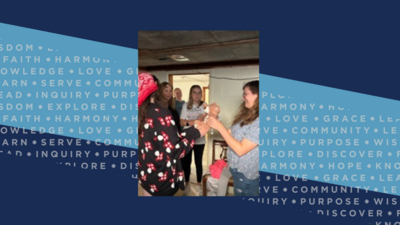
Undergraduate students in Dr. Anne Hobbs’ SOC 331 class recently had the unique opportunity to participate in a child welfare simulation that included members of the university’s theatre department playing the roles of parents and children. The experience took place at Concordia University, Nebraska’s Experience House/Crime Scene House, which is used to provide students in psychology, sociology, criminal justice and other disciplines with realistic training scenarios and experiences.
Hobbs serves as professor of human and social sciences at the university. The SOC 331 class – titled “The Family” – studies the family as a basic social institution, noting references to changing family structure and function. Students examine changing socials roles of family members and their impact on institutions such as schools and the church. For this experience, students responded to a mock call to the Department of Health and Human Services hotline.
“Through embodied learning, students engage their bodies, senses and experiences in the learning process, creating deeper connections between theoretical concepts and real-world applications that strengthen understanding, retention and critical thinking.”
“We explored how the state can take temporary custody of children in child welfare cases and how those decisions are made,” explained Hobbs. “After learning about ‘parens patriae’ the students visited a mock family who was experiencing socio-economic challenges that aggravated existing problems. Students were asked to determine next steps in the case. Would they recommend that the children be removed, or are there other interventions?”
Hobbs said that the university’s sociology, psychology and criminal justice programs have offered similar opportunities in the past and plan to continue to work in partnership to provide unique educational offerings like this for students.
“We hope to work more collaboratively to offer experiential learning and forensic experience. Hands-on learning allows students to move beyond simply reading and memorizing concepts in a textbook to actively experiencing, applying and making meaning of what they learn,” she said. “Through embodied learning, students engage their bodies, senses and experiences in the learning process, creating deeper connections between theoretical concepts and real-world applications that strengthen understanding, retention and critical thinking.”
Participating students included:
Kinlee Bruce, Hastings, Nebraska
Aubrey Burmeister, Albuquerque, New Mexico
Grace Drews, Tremont, Illinois
Benjamin Ehrenberg, Omaha, Nebraska
Ognjen Gajic, Liberal, Kansas
Ava Greene, Papillion, Nebraska
Rachel Holst, Hartford City, Indiana
Lance Kiango, McKinney, Texas
Lillian Loghry, Omaha, Nebraska
Xavier Marburger, Harvard, Nebraska
Elijah Meier, Palmer, Kansas
Chloe Powell, Marquand, Missouri
Nevaeh Rozell, Concordia, Missouri
Josie Smith, Sumner, Nebraska
Annika Staab, Grand Island, Nebraska
Whether students are preparing to serve as a Director of Christian Education, pursue a career in criminal justice or advocate for others through social work or psychology, they approach their studies at Concordia Nebraska through a Lutheran, Christ-centered lens connecting your faith to future professions. The Department of Human and Social Sciences at Concordia University, Nebraska equips students to better understand human behavior and relationships through critical thinking, research and experiential learning.
Interested in the behavioral science/sociology program at Concordia University, Nebraska?