The Gifts Beneath Our Feet
Presented on September 24, 2026, at the Lutheran Donors and Grantmakers Network Conference in Omaha, Nebraska
I would like to share four distinct stories that span over 2600 years and 6600 miles. At first glance, they may not seem to have much in common, but by the end, I hope you will see a clear connection and a compelling message for us to consider.
We will start with a journey into the Old Testament era, namely, a discovery that transformed a generation during the reign of a young king and his desire to restore and rebuild God’s temple. From there, we visit a small German town of maybe 2,500 people where another rediscovery arguably transformed the world and the history of Christianity. After that, we finally reach a depression-era, drought-devastated Nebraskan landscape and the vision of a small group of people that led to something that may well have grown far beyond what they expected. Then, staying in Nebraska, we visit one more story that was directly connected to a treasure hidden right beneath their feet, one that arguably transformed the landscape of the American plains and blessed countless people.
In fact, in all four stories, there is a shared theme of discovery and transformation, as well as being blessed beyond imagination by a gift, a treasure, hidden right beneath our feet.
Let’s begin with our first story, which takes us to somewhere around 640 BC in the Kingdom of Judah, more specifically in Jerusalem. A new eight-year-old king, Josiah, begins his reign, and about eighteen years in, he is ready for a major building project: restoring Solomon’s Temple. Many new leaders are drawn to a signature building project, and this King of Judah was no different.
Only, it turns out that the significance of the work had less to do with the building and more to do with what was discovered amid the work--what we might say was metaphorically hidden right beneath their feet. The high priest, Hilkiah, discovered something lost to the current generation: the Book of the Law. From the text, scholars are not quite clear which portions of Scripture were referred to here, but we know it was important and had been lost, leaving God’s people with only a partial understanding of their past, God’s promises, provisions, and His commands.
So, while King Josiah soought to restore the Temple, the Book of the Law, explaining an important part of the Temple's significance and teaching about the God of Abraham, Isaac, Jacob, and Judah had been lost. Without this full teaching from God’s Word, you could say that Josiah was leading a building campaign that was missing a critically important part of its purpose.
The temple was where God’s people gathered to worship Him, and where you would expect to hear God’s Word proclaimed in its fullness. Yet, for who knows how long, an important part of that Word had been lost, and the temple could easily have become a relic of a past era, with a watered-down or distorted understanding of the Truth.
What God’s people needed most had been there all along, even amid the deferred maintenance of a once beautiful place of worship and sacrifice that ultimately foreshadowed the greatest moment in history, yet to arrive.
When King Josiah learned of this discovery beneath their feet, he tore his clothes in grief and repentance. He recognized that he and God’s people had both lost sight of something incredibly important. Yet, now, amid this discovery, this building project took on greater meaning and significance than he ever anticipated at the beginning. Now, even more clearly, the restored temple would point to the God who revealed himself most clearly in the Holy Scriptures.
Now we move to our second story. Let’s fast-forward 2140 years and travel 1800 miles west to a small German town of perhaps 2500 people, about a third the size of Seward, Nebraska, where Concordia University, Nebraska, stands today. Here we meet a young, bright, deeply troubled, and struggling man named Martin Luther. Amid a journey through a dark, dreadful storm, and in a moment of great fear for his life, young Luther pledged to devote his life to God and eventually became an Augustinian monk.
Young Luther was devout, but he was also deeply troubled by his sin and his standing before a righteous and holy God. Luther knew his sin-stained life and heart, and nearly despaired of life itself, which drove him even deeper into a study of the Holy Scriptures. There, he discovered a truth and treasure hidden beneath his feet all along. Yes, God is righteous and holy, and He is just. Yes, all have sinned and fall short of God's glory. Yes, the wages of sin is death. And if it stopped there, Luther’s dread and despair would end the story. But through careful study of God’s Word, Luther learned that this same just God is also a God of great love and mercy, and so, “while we were still sinners, Christ died for us.” In the words of the Psalmist, Luther finally tasted and saw that the Lord is good. He tasted the sweet, satisfying, saving, and sustaining message of the Gospel. Luther learned that we are saved by grace, through faith, in Christ, not by works so that no one may boast. He learned that “the righteous shall live by faith” and that “A person is not justified by works of the law but through faith in Jesus Christ.”
Luther rediscovered a truth and treasure that had been lost to him and countless others, one hidden right beneath their feet, and he wanted to shout it from the rooftops, and he absolutely did that.
With the help of others, Luther quickly translated the Bible into the German language and became a fervent advocate for Christian education. He wrote a Small Catechism, which summarized key teachings in the Scriptures, and he spoke and wrote widely about the importance of creating and maintaining schools where God’s Word would be prevalent and pervasive, serving as a “lamp unto our feet and a light unto our path.” Luther knew that the treasures of God’s Word and the sweetness of the Gospel could easily be obscured or largely lost to the next generation if families and the church did not make Christian education a top priority.
From this came a movement that spread throughout the Western world and beyond, and the current and forthcoming families in Germany and beyond were blessed by this rediscovery of the treasure hidden right beneath their feet. In fact, families came to value that treasure of the Gospel so much that it was one, albeit not the only, reason some Germans of the eighteenth and nineteenth centuries immigrated to new homes in places like South Africa, Brazil, Australia, and the United States. Some sought freedom to raise their children according to their faith and confession, while others sought new opportunities, but many carried with them that precious treasure of the Gospel, and a commitment to establishing churches and schools where they could raise their children according to their consciences and that pure Gospel message that had been passed on to them.
This brings us to the third story: 4,800 miles West of Wittenberg, Germany, to the dust-covered and drought-ridden plains of Nebraska in the late 1800s. A group of largely first- and second-generation Lutheran immigrants made the plains their home. They established churches, and the same fervor for the Gospel and for passing on the faith from one generation to the next that Luther championed in Germany remained a top priority for these Lutheran Nebraskans.
Only, it was a difficult time on the plains. The 1890s brought years of drought that devastated crops and farms throughout Nebraska, creating an intense economic hardship that likely deepened the fervor of families and parishioners when they prayed those familiar words, “and give us this day our daily bread.” It is one thing to say that prayer amid times of plenty. It is an altogether different experience to say it when families wonder whether they will have enough food to feed their families the next day, week, or month.
Yet, even amid this drought and hardship, they knew the words of Jesus, recorded in the Gospel of Matthew, when Jesus said that, “Man does not live on bread alone, but on every word that comes from the mouth of God.” Even as many struggled with basic physical needs, they did not want to lose sight of the important spiritual needs for themselves and their children. So, continuing that great and long legacy, a small group began to plan and pray about establishing a new type of school in Nebraska, originally known as the Evangelical Lutheran Teachers Seminary.
A local family with roots in Seward to this day donated land. Others provided funds and resources to build the first campus building, which housed an inaugural class of thirteen students, along with the first President and Professor, Rev. George Weller. Rev. Weller, his wife, and this small band of students lived in that one building where they prayed, lived, studied, worshipped, and worked. From those humble beginnings came what is now Concordia University, Nebraska, currently serving nearly 1300 students, still serving as the largest provider of church workers for the Lutheran Church Missouri Synod. We do this while also being a school of choice for families who want a higher education that is truly grounded in the Bible as the inspired, infallible, inerrant Word of God—a place where God’s Word is present and prominent across the entire campus and all classrooms, where almost ninety percent of our faculty are members of LCMS congregations and one hundred percent of our faculty and staff confess creedal Christianity and the core teachings of God’s Word about Law and Gospel.
From early speeches and records, we know what they were thinking. An early twentieth-century speech tells us there were three priorities. First, raise future church workers, initially by preparing Lutheran teachers. Second, be a college where God’s Word is prominent, and be a school of choice for families who want a higher education that builds upon the faith taught to their children in the church and home. Third, be a type of community where we all point one another to the Lamb of God who takes away the sin of the world—not just the professors or administration, but students proclaiming Christ to one another, which is why it is one of my great joys each day when I walk into our daily optional chapel, and it is largely or entirely full of students and staff who choose to gather to hear God’s Word, pray together, and to enjoy Christian fellowship.
Once more, in this third story, we learn about a treasure hidden right beneath their feet. What started as a vision for a small teacher’s seminary grew into something that beautifully aligns with the founder’s core convictions and has become a great blessing to Lutheran families and their neighbors who are sympathetic to our Confession. In fact, almost those exact words appear in one of the earliest copies of our articles of incorporation. They had a vision for what could be, and God provided a treasure trove of people and support needed for it to grow, persist, and even flourish to this day, continuing that legacy of sharing the faith from one generation to the next.
Now we turn to the fourth and final story, one that, at first glance, might seem most disconnected from the rest. Yet, I ask for your patience and persistence to the end, where I promise that it all comes together.
Do you remember my reference of that great drought, depression, and dust-covered land where the seed of Concordia University, Nebraska, was planted in the 1890s, and God worked through people's prayers and generosity to water it and grow it into what it is today? What if I told you that, like all the other stories, the treasure that could nourish Nebraska's thirsty crops and soil was right beneath their feet all along? You see, while the land was dry and the times were hard, a treasure as precious as gold sat just beneath the ground: a collection of reservoirs connected to one of the largest and most significant aquifers in the entire world, just beneath the surface of those failing crops.
While the use of wells for irrigation went back for generations, the potential for how this treasure of liquid gold beneath the surface could transform the agricultural landscape would not be realized for decades, not until Frank Zybach, a Nebraskan farmer and inventor, developed the center-pivot irrigation system in the 1940s and obtained a patent for it in 1952. Among the earliest companies to license this patent was Valley Manufacturing (later known as Valmont Industries), which obtained permission in 1954. A young man in his early twenties, Rupert Dunklau, had started working there just a few years earlier. Before becoming Executive Vice President and Director of Valmont Industries, Rupert was a bookkeeper on the ground floor of this rapidly expanding operation that would help turn once dust-covered soil into green, flourishing crops and farmland for generations to come.
In 1955, T-L Irrigation began in Hastings, Nebraska, when LeRoy Thom and J. Gilmore Love founded a company to serve farmers’ irrigation needs. They also played a key role in providing the irrigation systems needed to tap into the great blessing and benefits of water beneath Nebraska farmlands.
Yet, even Rupert and his beloved wife Ruth didn’t realize that his early vocation as a bookkeeper was preparing them for something else as well. You might say they were being prepared to become yet another source of great blessings right beneath our feet. In 1968, they established the Rupert and Ruth Dunklau Foundation, and in a very real way, you could say this Foundation continues that legacy of a different type of “book keeping,” which aligns beautifully with every story I've shared so far. Their generosity has directly supported and sustained any number of schools and ministries devoted to being not only places where the Book, God’s Holy Word, is kept, but it is taught and proclaimed from one generation to the next. Like these resources beneath our feet that bring life and growth to the crops of the plains, so the resources of this Foundation give growth and blessing to places like Concordia University, Nebraska.
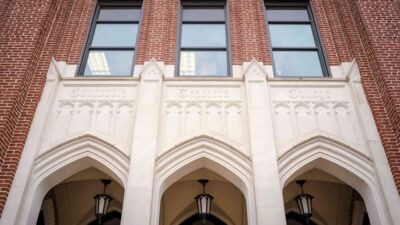
In 1994, the LeRoy Thom, Jean Thom and T-L Foundation was formed, and this family embraced the same faith, the same deep love for Lutheran education, and the same desire to pass the Gospel on from one generation to the next. If you walk the Concordia University, Nebraska campus today, you will see the beautiful Dunklau Center for Science, Math and Business, which houses a collection of inspiring, Christ-centered academic communities. You will also witness the Thom Leadership Education Center, where many of our future Lutheran teachers are being equipped for the harvest field. These are both prominent buildings on campus, and in them, just like the restored temple with the rediscovery of the Book of the Law, you will see that they are places where God’s Word is present and prevalent, shaping and informing faith and learning across the curriculum, and regularly pointing students to the Lamb of God who takes away the sin of the world.
If you walk through our student center to our newly renovated Cattle Conference Room, rightly named after yet another family and community partner that supported and sustained this University mission over the years, you will now see a large and inspiring art installation that includes over five hundred names of families and foundations, each representing a distinct University endowment that waters the seed of God’s Word planted in the hearts of our students, helping our students and community grow and extend God’s blessings throughout the state, region, nation, and to the ends of the Earth. This piece of art was designed to reflect an aerial view of Nebraska farmlands transformed by pivot irrigation systems that bring the treasure beneath the ground to the crops growing above. After all, that is at the heart of every story you have heard so far. Each one tells of planting seeds, watering, tending, and God turning dusty, dry lands and hearts into places of faith and life.
You see, every one of these stories is about God’s great provision and the gifts often right beneath our feet, but they also ultimately point us to another place where everything else is held together, not a place beneath our feet, but the place beneath the feet of Jesus Christ on the cross. There we sit, beneath His feet, as God declares that we are His great treasure, loved so deeply and dearly that He sacrificed His own Son for our sins, so we might enjoy life to the full with Him now and life with Him in the future.
Beneath those feet, all these other stories come together…and are held together. It is there that our shared work takes on eternal significance as we heed the call to pass on this Good News from one generation to the next, praying that God would provide all that is needed to equip a next generation who will go on to live loved by God in Christ and then to love their many neighbors in the world, becoming great blessings in their families, churches, communities, workplaces, and the world—pointing people to God’s treasure right beneath their feet and to the place beneath the foot of the cross of our Savior where we are reminded how much He loves and treasures us in Christ.