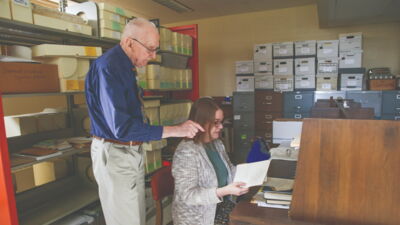
Guardians of History
Story: Dr. Hannah Kroonblawd ’12 and Dr. Jerry Pfabe
Photos: Liz Kucera
Through the faithful work of its archivists, Concordia continues to preserve the stories that shaped its past and guide its future.
Dr. Jerry Pfabe
I was a relatively new professor at Concordia Teachers College when President W. Th. Janzow appointed me to be the college archivist in 1970. I had no training as archivist nor did I know much about Concordia’s history. I was an historian, so the prospect of working as archivist appealed to me. The existing archival materials were quite limited. Along with my own library, they were in several boxes in my small office in College West.
Gradually I gathered more materials for historical preservation. Before long we moved the collection to a former professor’s office in Link Library. A few years later we had outgrown that space, so the archives moved to a room next to the current Bartel’s Rock Museum in the library basement. Again, that space became greatly overcrowded, and the southern end of the lower level of “old” Link was available for the archives, where our historical collection now resides.
At first there was no filing or organizing framework, so I had to develop that. I itemized the items in our collection using blank 3 x 5 cards. Later, when our computer system was enlarged, I was able to classify our holdings into a digital format and then organize specific materials in a usable and flexible system. Some years ago, we added a scanner to the archives that made possible the sharing of materials, such as historical photographs, to others.
For many years after I became archivist, there was little demand for use of archival materials from individuals or offices on campus and off campus, but that has changed considerably in recent years. We have received many requests for information from many offices or programs on campus, such as providing photographs and data for reunions of football and men’s basketball teams. Special to me have been queries from individuals off campus for information about their ancestors who attended Concordia. Usually, we have been able to find some information for these persons. Responding to those requests has been a rewarding part of serving as archivist.
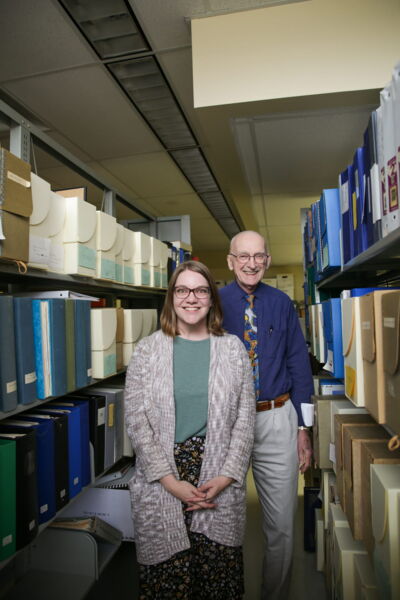
The archives have received many gifts from thoughtful individuals. The family of art professor Reinhold Marxhausen has given the archives an enormous collection of records of his activities and achievements. Likewise, we have a sizable collection of the work of music/psychology professor Theodore Stelzer. Many less extensive gifts from countless donors have enriched our archival holdings.
Learning about the history of Concordia through being archivist for many years has been very rewarding. The school has gone through so many changes and challenges, moving from a three-year high school to a six-year high school/college teacher education program, to a four-year degree in Lutheran and public elementary and secondary education, to liberal arts, pre-professional and graduate programs. The school has experienced periods of enrollment growth and declines, of financial ups and downs. However, the school has consistently striven to maintain its identity as a Lutheran Christian school of higher education.
In the past year or so, it became evident to me that Concordia should have a new archivist. I am pleased that Dr. Hannah Kroonblawd, a former student of mine and a recent addition to our English faculty, accepted this responsibility. She will bring renewed energy, dedication, skill and creativity to this work.
Dr. Hannah Kroonblawd
Dr. Jerry Pfabe approached me in November 2024 to see if I’d be interested in learning more about the archives. Jerry was nearing retirement from his university archivist role, a position he had held for 55 years. I spent the next few months shadowing Jerry as he filed documents, answered queries and located photographs. He oriented me to the range of materials the archives holds: blueprints of campus buildings, faculty publications, presidents’ speeches, accreditation files, music recordings… So many different facets of the people who come to Concordia and how God has worked through them both here and afar.
My own work as Concordia’s archivist officially began on July 1, 2025. Since then, I’ve spoken with family members of past faculty, located historical photos for a range of campus events and projects, researched program policies and sent alumni information to a local historical society in Kansas. Jerry’s organizational system serves me well as I comb through boxes of files, photograph albums and 100-year-old Broadcaster copies.
The archives is just one way Concordia is working to preserve that story, to reflect the provision and mercy of God that continues from generation to generation.
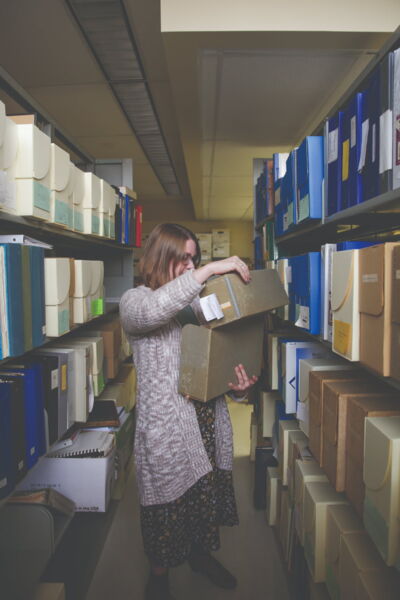
There are many opportunities for the future of the archives and the preservation work that happens here. Currently, the archives primarily exist in physical form; digitizing archive materials would allow access not just to those on campus but to anyone interested in Concordia’s history. There is also a bit of a gap in what we have on-file given the leap from the pre-2000s analog era into the digital age. Preserving Concordia’s present, as well as its past, is a work in progress! I pray that future generations are able to see the story of God’s provision and purpose across the entirety of Concordia’s history, from 1894 through the twenty-first century.
Our students, here in the present, have personal ties to Concordia’s past—not just to the physical history of the Seward campus, but through the varied paths that led them to Seward. Many students have parents, grandparents, aunts or uncles who attended Concordia. Many students receive encouragement in their decision to attend Concordia from a pastor, teacher, coach, DCE or parish musician who were themselves a Concordia Nebraska student. The Concordia story is filled with faithful people serving God and pointing to Christ both inside the college classroom and beyond it, bringing the hope of the Gospel to a world in desperate need of it.
Today’s students are in the middle of Concordia’s story: through the classes they take, the chapel services they attend, the games they play and music they perform, the walks taken across the quad, the meals eaten in Janzow, the late nights in the dorms. Today’s faculty and staff, too, are in the middle of Concordia’s story, a community story that is intent on loving and serving one another as we love and serve our students. The archives are just one way Concordia is working to preserve that story, to reflect the provision and mercy of God that continues from generation to generation.