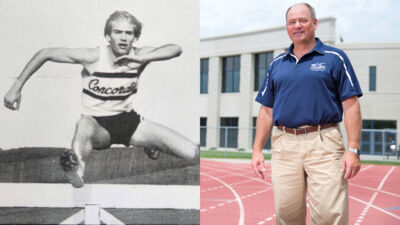
Plop down next to Dr. Kregg Einspahr on the park bench. If you can maneuver past the small talk and get him going, Einspahr will take you on a remarkable journey. Where do you start with a man whose keen intellect and extensive education are perhaps matched only by his astounding athletic achievements and coaching résumé? The scope of Einspahr is that of a man characterized by longtime assistant coach Ed McLaughlin as “annoyingly bright” while simultaneously worthy of being declared by the Lincoln Journal Star as one of Nebraska’s Athletes of the Century for the 1900s.
One doesn’t reach such heights or garner such descriptors without having veered from the beaten path. In the prime of his athletic career, Einspahr sought adventure like hounds on a trail. Einspahr was willing to run to the ends of the Earth to chase dreams that felt wilder than fiction.
Says Einspahr, “I was very fortunate. Sometimes I feel like Forrest Gump. I’ve been all these places and seen all these things. I got to sit at a picnic table with Wilt Chamberlain. I was in a race where an American record was set. I got to compete against some of the best in the United States and run in Olympic stadiums in Europe and the United States. I always feel very fortunate about that.”
And that’s just a single thread of the story for one of Concordia’s most iconic figures. As a Bulldog student-athlete from 1978 to 1982, Einsphar won six individual NAIA national championships before being inducted into the NAIA Hall of Fame in 1992. He also nearly made the Olympic team having run at the U.S. Olympic Trials of 1980, 1984 and 1988. Little did he know at the time, there would be a second act at Concordia for Einspahr, who would become the first national championship winning head coach in school history.
From each of these experiences, there’s hardly a moment that Einspahr fails to recall within his steel trap of a mind. Kregg Einspahr is Concordia and Concordia is Kregg Einspahr. As another of his trusted assistant coaches, Mark Samuels, remarked, “This has been his life as an athlete, a coach and a professor. He’s poured his entire professional life into Concordia, which is cool … It’s pretty remarkable the influence he was able to have in growing the university.”
The phone booth
The entire life story for Kregg Einspahr may have played out differently if not for one critical conversation that took place in the summer of 1978. When Einspahr made his commitment to attend Pacific Lutheran University, Concordia had been in between track/cross country coaches and lacked the type of athletic facilities that would appeal to top recruits. Despite the limiting factors, Einspahr still felt the pull of Concordia Nebraska, where his parents first met and the place his older brothers Kelvin and Kent made their college destination.
As Einspahr was quoted as saying in a 1982 Lincoln Journal Star article, “I call myself a Nebraskan. I like the people of Nebraska. The only thing I don’t like is the cold, windy Marches.”
But the family had relocated to Portland, Oregon, where Einspahr attended a small Lutheran high school. A multi-sport star, Einspahr spent a portion of the summer of ’78 in Baker City, Oregon, which hosted the state’s shrine football all-star game. Einspahr says that he was registered for classes at Pacific Lutheran when newly hired head coach John Knight came calling. A graduate of Linfield College in Oregon, Knight himself was familiar with the Pacific Northwest and was aware of Einspahr’s athletic talent.
It seemed that Einspahr simply needed a nudge in Concordia’s direction. “I still remember taking a call from him in the phone booth and talking to him,” Einspahr said. “I just really liked what he had to say, so I decided at the very end to come to school here. It was kind of last minute. I was a coach’s nightmare because I never told the coaches at Pacific Lutheran. It was their fault as well because they didn’t really stay in touch with me the whole summer.”
The phone booth conversation came during preparation for the shrine game. According to John Knight’s wife Susie, both she and John were in attendance to watch the 1978 Oregon shrine game. As Susie said in a 2023 interview, “John was diligently trying to recruit him … He turned out to be an outstanding athlete and John was able to coach him. He was the beginning of the team because he came with us. Because of Kregg’s success, John was able to recruit other kids to come.”
Ultimately, Einspahr couldn’t resist the family’s prized institution, Concordia. It’s where his father from Wilcox, Nebraska, and mother from the prairies of Canada came together in strengthening the family connection. Both parents became Lutheran teachers. Their vocational pursuits migrated the family to the cities of Perry, Oklahoma, Tacoma, Washington, and Portland, Oregon. As Einspahr recalls, his parents drove the family through Seward when Kregg was around the age of 11. “Why are you doing this? I don’t want to go through this little town,” Kregg told them. Unbeknownst to young Kregg, this was home. There was no avoiding the magnetic-like forces.
Seven years later, Einspahr re-emerged at 800 North Columbia Avenue. And so began an era of track & field superstars at Concordia. Einspahr predated the likes of eight-time national champion Carol Bailey, five-time national champion Gene Brooks and three-time national champion Patrick Gellens (all coached by Knight). But those names were all unknowns as the fall semester of 1978 got underway. In those days, it wasn’t so rare for collegiate athletes to compete in multiple sports.
Einspahr planned to give football a shot for then Bulldog head coach Larry Oetting. Einspahr arrived a few days late for the beginning of preseason practice. His days as a college football player were short-lived. As Einspahr explained, “I ended up getting hurt really badly with a kidney injury. I got hit in the back and ended up having a bleeding kidney. I was in the hospital for two weeks. That’s when I had to decide if a 5-11, 160-pound receiver was going to continue to play football or run cross country. I decided to go the cross country route. The rest was history.”
Triumphant return to Concordia
Try as he might, Concordia would never leave him. By August of 1988, Einspahr’s graduation had been more than six years in the rearview mirror. He wasn’t ready to return to Seward, with the exception of an occasional visit. Einspahr had just run at the Olympic Trials for a third time when Paul Hammel of the Lincoln Journal Star caught up with him. At 28 years old, Einspahr was in the process of completing his doctoral studies in biology at the University of Texas.
In Olympic Trials No. 3, which took place in Indianapolis, Einspahr finished the 3,000-meter steeplechase in 8 minutes and 28 seconds (five seconds off his personal best), not quite fast enough to make the Olympic team. Einspahr knew there were things he could have done differently to perhaps affect a better outcome. At this stage, Einspahr wrestled with whether to continue his running career or pursue endeavors that provided a steadier income. Einspahr told Hammel, “If I keep getting better, I’ll stick with it a while. If I don’t, I’ll have to re-evaluate the situation. Maybe it’s time to move on and get a real job and get to work.”
Einspahr admits that he loved learning and running so much that he just kept going to school while pacing the local tracks and trails wherever his travels took him. After earning his Ph.D. in biochemistry and physiology from Texas (which followed the completion of his master’s in physiology from the University of Nebraska in 1985), Einspahr relocated to Rochester, Minn., where he served a three-year fellowship at the Mayo Clinic.
To this point, Einspahr had not landed a gig or settled anywhere he considered anything close to permanent. Having spent his adult life as a student or graduate student, Einspahr wasn’t exactly making bank. At 28 years old, he even called his dad to ask for a loan of a couple hundred dollars. As Einspahr pondered the future, he spent a year teaching at Texas (one class per semester) before deciding “it was time for me to move on.”
As part of his role at the Mayo Clinic, Einspahr wrote scientific journals that were published by the National Academy of Sciences. Well-educated, brilliant and driven, Einspahr had begun to forge a career path as a research scientist. It just didn’t sit right with Einspahr, an adventurer who couldn’t bear the thought of toiling the remainder of his career in an office behind a desk.
More than 400 miles away, early in 1992, then Concordia Athletics Director Carl Everts was in the beginning stages of searching for a new head coach for the cross country and track programs. Former head coach Brian Stacy resigned the position after the indoor track season. It wasn’t long after that a letter reached the desk of Einspahr at the Mayo Clinic. This was his call to come home. Said Einspahr, “I put it under some stuff and let it sit for three weeks. I pulled it out again and put it back. It sat there another month or two.”
Einspahr began looking more seriously at coaching as a profession. Thanks to his level of achievement and vast network in the sport of track and field, Einspahr wasn’t without options. One stood out. His brother Kent worked at Concordia and his parents decided to retire in Seward. Said Einspahr, “I thought I had something to offer Concordia that I couldn’t other places. I thought I could help foster some development in track and field. Somehow the spirit moved me and I applied and decided this is where I wanted to be.”
The hiring of Einspahr at Concordia was made official in a news article in the Lincoln Journal Star dated June 3, 1992. He was introduced as the man who won six national championships as a Bulldog athlete. Of course, Einspahr wasn’t coming to Concordia to produce merely average results. He was thinking big.
At least initially, Einspahr was tasked with attempting to make chicken salad without the necessary ingredients. The facilities and resources made it an exceptional challenge to compete with the very best of the Nebraska-Iowa Athletic Conference (newly dubbed in 1992). His office itself was rather modest, a dark and tucked-away hole in the wall situated next to the football locker room, not so pleasant on the olfactory system. When Einspahr walked into his office for the first time, he saw a file cabinet lying on its side and an overturned chair. It needed some TLC to be sure. The scene was representative of the work that lie in front of him.
Einspahr asked himself, “Why did you ever come back here?” He answered, “I guess for the challenge.” The track teams had sunk to the bottom of the league standings, but Einspahr was the right man with the right determination for the job. Einspahr brought instant credibility. With his own legendary career as an athlete mostly behind him, Einspahr was ready to prove his coaching chops in his first run as a head coach.
The making of a legend
Six national championships. Three U.S. Olympic Trials. NAIA national championships record breaker in the indoor mile and indoor two-mile. NAIA Hall of Famer. A Lincoln Journal Star Athlete of the Century. The résumé speaks for itself. The terms “legend” and “GOAT” are tossed around much too often in sports, but they aptly apply to Einspahr.
In a 2023 interview, his college coach John Knight, from his home in Oregon, marveled in reminiscing, “He’s probably the finest athlete we’ve ever had at Concordia. He ran cross country and drilled everybody in our conference. He wanted to come to Nebraska because his parents had come to Seward. There were all kinds of Einspahrs. I had a little bit to do with it. He was so good he was able to win national championships. He was just a great athlete.” Knight also told the Lincoln Journal Star in 1982, “I wish I knew where I could find another one like him.”
But back in the 1970s, a youthful Kregg Einspahr had only just begun to lay the groundwork for what was to come. Einspahr says he spent the first 10 or 11 years of his life in Oklahoma, where his parents both worked in the Lutheran school system. His father later became principal at a Lutheran elementary school in Tacoma, Washington, necessitating the family’s move to the Pacific Northwest. The next stop was Portland, where Einspahr spent his high school years.
Einspahr won state championships in the mile and two-mile, qualified for state in the javelin and broke the Oregon state small schools record in the mile. He also played football, basketball and baseball and ran track. Einspahr earned all-state football accolades and an invitation to the shrine all-star game. As Einspahr said in 2023, “The things I did then probably would have gotten more attention in today’s day and age. I was a small school athlete.”
In other words, Einspahr was gifted with a baseline level of talent, enough to make him a top recruit for the program Knight was hoping to build at Concordia. Einspahr entered college with a mile time around 4:17 at a point when some of the best athletes in the state of Oregon were running roughly 10 seconds faster. He knew he was good, but he wasn’t yet elite. In order to close the gap, Einspahr would have to put to use his tireless work ethic and drive to be great.
The kidney injury and subsequent hospitalization slowed Einspahr at the start of his college career, but it failed to deter him. In the spring of 1979, as a freshman, he ran the mile in 4:17.9 and placed as the runner up at that year’s Nebraska Intercollegiate Athletic Conference Championship outdoor track meet. Einspahr wasn’t going to be satisfied. His transformation would come that summer.
As Einspahr recalled, he put in a grueling 60-to-70 miles every week while also working 40-hour weeks of manual labor alongside his brother Kent. On some days, Einspahr ran as many as 20 miles – 10 in the morning and 10 in the evening. His training that summer completely changed the game. Those athletes who thought they were on par with Einspahr were about to be left in the dust.
Said Einspahr, “By the time I came around that fall and towards the end of cross country, I was a horse. What’s amazing is I was able to stay healthy. I didn’t have joint pain, and I didn’t have stress fractures. I was putting in about 70 miles per week all summer long. That made me a whole different animal. I went from a 9:13 steeplechase to being in the finals of the Olympic trials the next year. It really changed me. I had never done a lot of mileage. Back in high school, I had never done a track workout. I would just go out and run.”
Running is what Einspahr did better than just about anyone. In the fall of 1979, he won his first of three straight NIAC individual cross country championships. On the track, Einspahr became a national sensation and someone capable of beating competitors from much larger schools. He won NAIA track national titles (in order) in the 1980 indoor two-mile, 1980 outdoor 3,0000-meter steeplechase, 1981 indoor two-mile, 1981 outdoor 3,000-meter steeplechase, 1982 indoor mile and 1982 outdoor 3,000-meter steeplechase.
So impressive were his efforts as a college athlete that even 44 years after his graduation, Einspahr continues to own school records for indoor track in the mile (4:02.51), the 3,000 meters (8:05.60) and the 5,000 meters (14:19.55) and for outdoor track in the 3,000-meter steeplechase (8:30.06). At the time he finished his college career, Einspahr owned NAIA national championship meet records for the indoor mile, indoor two-mile and steeplechase. The steeplechase became Einspahr’s specialty. It’s an event he won while up against a loaded field of NCAA Division I athletes at the Drake Relays in both 1981 and 1982.
As Einspahr told the Journal Star in ’82, “Winning at Drake was equal to or an even bigger thrill than the NAIA titles. It’s bigger and more prestigious. When you win at Drake, people sit up and take notice.”
All of these extraordinary heights were reached as Einspahr made the best of Concordia’s meager facilities and resources. Einspahr called it “adaptive track & field.” Concordia had no steeplechase water jumps or barriers. Longtime athletics equipment manager and athletic trainer Stan Schlueter fashioned some steeplechase barriers out of railroad ties. Einspahr would have to make do with such creative solutions and be satisfied with a cinder track. When Einspahr ran his first Olympic Trials, he wore hand-me-down junior varsity basketball shorts. He also had to plead his case for more scholarship money as the national titles piled up.
Despite some of the obstacles Einspahr faced, he developed an appreciation for Coach Knight, who commanded a high level of respect in his own right. Knight served such roles as President of the NAIA Track & Field Coaches Association and U.S. Olympic Development Committee member. Einspahr credits Knight with helping increase his exposure on the national and international scenes.
“John was a tremendous facilitator in opening doors for me as a small college athlete,” Einspahr said. “He got me into a big meet in Wichita after my sophomore year that allowed me to qualify for the Olympic trials. Once I did that, he got me in the Prefontaine Classic in Oregon. I did really well in that meet and it set me up for the Olympic trials in 1980. He helped open a lot of doors. I ran in some of the biggest meets in the United States.” As an aside, Einspahr appeared at such famed American venues as the LA Coliseum and New York City’s Madison Square Garden, in addition to numerous other places across the country and internationally.
Naturally, Einspahr became a celebrated athlete at Concordia. He appeared on the cover of the fall 1981 Concordia College “Sports Preview” as the most recognizable athlete on campus. When the athletic department selected its inaugural Concordia Athletics Hall of Fame class in 1994, Einspahr was a no-brainer for induction. In December 1999, the Lincoln Journal Star tagged Einspahr with incredibly lofty distinction as one of its state college “Athletes of the Century.”
By the late 1990s, Einspahr had dropped anchor in Seward, had married his wife Suzanne (a Doane alum!) and was already well on his way to achieving legendary status within the coaching profession. The opportunity to impact the lives of student-athletes outweighed any feat Einspahr could ever achieve on the trails or tracks.
Notably, Suzanne became an assistant coach. Kregg credited her with implementing some ideas that aided in the rapid ascent of the women’s cross country program. As Kregg said in 2024, “She was a huge help for an assistant coach and as a wife to a coach that is working most days of the week and is out late recruiting and spending Saturdays at track and cross country meets.”
The Concordia icon: coaching legacy
Out of love and admiration for his alma mater – and his own competitive fire – Dr. Kregg Einspahr wanted better for Concordia. Times were different back in the early 1990s when Einspahr took on the task of building the cross country and track programs. The entire Concordia athletics department operated out of one main building, the Physical Education Center, which struggled to meet the demands of coaches and athletes, but most of them didn’t know any better.
Ed McLaughlin arrived at Concordia as a freshman in 1993 as he signed on to play football and throw for Einspahr’s early Bulldog teams. Explains McLaughlin, “When I got here, the track team was about 26 kids fitting into one classroom. Some of them were cross country runners with a sprinter here or a jumper there. Most of them were dual sport athletes. I played football, a buddy of mine did soccer and we had people who were playing basketball. It was totally different.”
Over 24 seasons (1992-2016) as head coach, Einspahr would bring Concordia track and cross country into the modern era while completely transforming the two programs. The accomplishments during his tenure were staggering:
· Two NAIA team track & field national championships (2015 men’s outdoor / 2016 women’s outdoor).
· Seven combined NAIA team national runner-up claims between cross country and track & field.
· 32 combined NAIA team top 10 national finishes between cross country and track & field.
· 312 NAIA All-Americans coached in track & field.
· 30 NAIA All-Americans coached in cross country.
· 27 NAIA national championship athletes coached in track & field.
· Three NAIA national coach of the year awards.
· 19 GPAC coach of the year awards.
· 16 combined GPAC/NIAC team conference championships between cross country and track & field.
But in the fall of 1992, Einspahr was a rookie head coach (combined with his duties as a science professor) tasked with making the most of limited resources and staffing. It was unrealistic at that time for one man to build a track roster with depth across all event areas. With his background as a distance runner while possessing an expertise in distance training, Einspahr naturally placed his initial focus on recruiting and developing distance and mid-distance runners who could compete in cross country and track. Einspahr was going to build it from the ground up. While he had not previously been a head coach, Einspahr had a distinguished mentor to look up to in Stan Huntsman (a highly successful collegiate and Olympic coach), who coached Einspahr during his time at the University of Texas and while training for the Olympic Trials.
As Einspahr explained, “We made more progress to begin with in cross country because we didn’t have an indoor track. You have a jumper or a sprinter come in and they look out in the winter and there’s 11 inches of snow on the ground. They’ll say, ‘Where am I going to train?’ You have no answer for them. Middle distance and distance – it was a little easier to do that when you’re not depending on the same facilities that everybody else has. You have the open roads and trails – so we made more progress in cross country.”
(Said Einspahr of what he gathered from his friendship with Huntsman, “He had a lot of new and different ways of training that I hadn’t seen before. He had learned a lot from Eastern Europeans about how they trained. He became a close friend of mine. I learned a lot from him.”)
** As a mildly relevant side note, Einspahr was still finding ways to run competitively into his 30s. A blurb in the Lincoln Journal Star in 1992 mentioned that Einspahr won Lincoln’s third annual Jingle Bell Run in a five-mile time of 27 minutes, 41 seconds. He was 32 at the time. Still got it! **
Somehow, Einspahr convinced athletes to come to Concordia, a place with only a gravel track and no real indoor or outdoor facility. The Bulldogs were several steps behind rivals like Doane and Nebraska Wesleyan, which had their own indoor tracks. Behind the scenes, Einspahr lobbied for advancements that could help elevate the program. At the same time, Einspahr came up with creative ways for his athletes to train. If it snowed, Einspahr would grab a shovel and clear the track (later in his career, he upgraded to snow blowers). Einspahr and his staff, which later included McLaughlin and pole vault coach Gene Brooks, would also funnel athletes to places like the University of Nebraska’s Devaney Center, the Abbott Sports Complex or even the Ag Pavillion or Armory in Seward.
The off-campus options meant late nights after class for coaches and athletes. It wasn’t a long-term recipe for roster growth or athletic success. Fortunately for Einspahr, President Orville Walz became an advocate for a project that would greatly enhance the stadium and outdoor track. As Einspahr recalls, the university broke ground on the project in 1996 and the first official outdoor meet in the refurbished facility was held in 1998.
A funny thing happened in ’98. Concordia celebrated its first ever conference championship in the sport of women’s track & field. A headline in the May 3, 1998, edition of the Lincoln Journal Star read, “Concordia star shines bright as Doane’s track dominance ends.” What Amy Luft achieved at the 1998 Nebraska-Iowa Athletic Conference outdoor meet was the stuff of legend. She won both the 5,000- and 10,000-meter runs and placed second in the 1,500 and 3,000, leading the way to a team title.
It marked a major turnaround from Einspahr’s first conference meet as head coach. At the 1993 NIAC indoor meet, Concordia placed dead last (sixth out of six) on the men’s side with six team points and finished fifth place (out of six) on the women’s side with 15 team points. To this day, Ed McLaughlin isn’t sure he’s ever seen Einspahr any happier than he was after that ’98 conference title. Said McLaughlin, “The whole goal was to win conference titles. Obviously, we had that other dream out there. We literally built the stadium and right after it win a conference title.”
For much of the 1990s, Einspahr’s programs were like the little engine that could, eating away at their conference rivals and leveling up, brick by brick. For the time being, it was about finding ways to do more with less. In 1993, Einspahr scored one of his first major recruiting wins when York’s Tommy Grabowski joined the Bulldogs. Grabowski established himself as one of Einspahr’s first great runners. When Grabowski placed 30th at the 1995 NAIA Cross Country Championships, he became the men’s cross country program’s first All-American since Einspahr himself in 1979. Luft would soon follow as an accomplished performer on the women’s side.
“We had a long ways to go,” Einspahr said. “Part of it was doing whatever we could to recruit. I did get a fella in who was one of the best runners in the state. His name was Tommy Grabowski. When I got him, some of the other top runners in the state kind of woke up and thought, whoa. That helped a lot. Within a couple years, we won our first conference championship on the women’s side. We just tried to have some success and win with what we’ve got.”
Many more All-Americans in track and cross country were coming up on the horizon. By Einspahr’s third year at the helm, the women’s cross country team had cracked the NAIA top 15. By year five, the men crashed the top 20. It was only going to get better.
On the heels of Grabowski arrived Brandon Seifert out of Grand Island, Nebraska. Before his graduation in 2001, Seifert would become a track national champion in the mile and an 11-time All-American between cross country and track. In some ways, Einspahr saw a younger version of himself in Seifert, particularly in his unwavering pursuit of competitive greatness. The future doctor Seifert had the talent and ability inside him. With Einspahr’s prodding, he became one of the best to ever compete at Concordia.
Seifert still remembers the time Einspahr visited his home as part of the recruiting process. Once Seifert experienced the Concordia campus, it was all over. Seifert knew where he was going. He wanted to be at a Christian university – Concordia seemingly had it all, including a coach he bonded with instantly.
There are so many stories Seifert could tell about Einspahr and about his competitive days at Concordia. One specific story captured Einspahr’s ability to inspire and to motivate and how to compete with the proverbial chip on the shoulder. Einspahr LOVED anything that provided a mental edge or fed into the underdog mentality. At a meet hosted by the University of Wisconsin-La Crosse, Seifert knew he would be going up against All-Americans from the NCAA Division I level.
Said Seifert, “I still remember walking up to the line and looking at those guys and saying to Coach Einspahr, ‘Wow, those guys are really fit.’ He looked at me and was like, ‘Have you looked at yourself in the mirror lately? You look just like those guys.’ That was such a confidence boost. I went out and almost beat their top guy (from the University of Wisconsin-Madison). I got second that day and I beat their second guy who was a Division I All-American. Those things that Coach Einspahr would say were awesome and so motivating. Those were things that put you at that next level mentally to go compete at that level.”
Indeed, Einspahr’s teams made a habit out of punching above their weight class. By the mid-2000s, Concordia had largely shed the underdog role, even if Einspahr still liked to play it up. In the fall of 2004, Molly Engel (married name Christensen) led the way for one of the finest teams Einspahr ever coached. In her storied cross country career, Engel won three individual conference titles and earned three All-America awards. The vaunted ’04 team held down the top six place finishes at the Great Plains Athletic Conference championships, won the regional title, earned an NAIA No. 1 ranking and ultimately finished as the national runner up.
Engel and her fellow classmates were an impressive bunch. Her senior class also included the likes of Jennifer Nikkila, Michelle Quinlan and Kelly Waterman. Engel recalls how emotional Einspahr was when the 2004 squad gathered together for a final meal as a team. Engel points to Einspahr as one of the top three mentors in her life.
As she said in the summer of 2025, “I would describe Coach Einspahr as very tough, but in a good way. You need a tough coach for college. There’s no way around that. When I reflect – it’s been over 20 years now – he really developed my mental toughness and confidence as a runner. The way he developed that, he did a great job. He prepared me to run at as high of a level as I could when I was in college. His toughness spread among the athletes with how he would coach us and how he would talk to us.”
In addition to instilling toughness, Einspahr instilled knowledge and an understanding of how the body would respond to the training that he professed.
Continued Engel, “You typically don’t see coaches at the collegiate level that have all of his exercise physiology background and all of his research background. He would have us sit in the classroom and he would teach us proper nutrition. He would be writing out formulas on the chalkboard and actually be teaching us. This is what’s going on with your body. This is why you’re tired. This is why you need to go through this training cycle. He would go through all that stuff and break it down. This is why it’s going to work. He was very unique and I was very blessed to have him as a coach.”
Whether All-Americans, conference champions or many of the other hundreds of athletes Einspahr coached, they likely all have their own stories on ways that the Concordia icon impacted their lives. Through the years, many Concordia Athletics Hall of Famers coached by Einspahr have reserved time to recount memorable anecdotes.
Once a scrawny young man who mostly just wanted to kick field goals for the football team, Michael Saalfeld became an 800-meter national champion under Einspahr’s tutelage. As Saalfeld said in a 2019 speech, “Coach Einspahr had different plans for me. He decided to put me in an 800-meter relay one of the last meets of the season. I was thankful I did it. I ended up running one of the best times on the team. I got to nationals and I started to feel like I had something. It dominoed from there. I thank you so much, Kregg, for being there for me and for pushing me in the right direction. God knows I would have just been a football player – that wouldn’t have worked out.”
Another Concordia Athletics Hall of Famer, three-time cross country All-American Andrew Walquist had this to say of Einspahr in 2022, “He had such a pedigree even before I went there. He knew how to develop good runners. What struck me the most was that he really, really cared about his athletes and he really cared about the program. You could see his passion come out. I think his passion led us all to respect him more and compete better.”
The success of Concordia track and cross country kept reaching new heights as Einspahr pushed for more staffing and resources. Eventually, the construction of the Walz Human Performance Complex, complete with an indoor fieldhouse and track (which hosted its first meet in 2010), and additional coaches gave the Bulldogs the type of advantages Einspahr had dreamt about back in 1992. The act of shoveling and snow-blowing the outdoor track became a distant memory. Within his staff, Einspahr established continuity as Ed McLaughlin, Mark Samuels and Jason Berry remained loyal as longtime assistants.
Before overseeing 20 national championships in throwing events, McLaughlin got his start as a part-time assistant. Einspahr roped him in early in his head coaching tenure. McLaughlin understands what it took for Einspahr to build the cross country and track programs to a point where they could compete for national titles. As McLaughlin said in recalling his days as a Concordia athlete, “I don’t know how we had the budget for equipment.” In his fifth year as a Bulldog, McLaughlin began helping coach the throwers.
That was the start. The next year, McLaughlin began receiving a $1,000 yearly stipend to coach the throwers. It took roughly a decade before McLaughlin became a full-time employee at Concordia. Despite the challenges (which meant working his bills-paying job in Lincoln), McLaughlin felt an intense loyalty to Einspahr.
“I don’t know what you say about the guy who gave you your first everything,” McLaughlin said. “He’s the one that wrote the scholarship that got me to Concordia, as I’m getting ready to not come to Concordia. He’s the one that asks me to help coach and then turns around and asks if I want to keep coaching. He mentored me through a lot of stuff. He didn’t have to. We joke about it all the time. I still don’t know why he likes me. We butted heads. At the end of the day, he was great to have as a head coach.”
Ahead of the 2007-08 academic year, Einspahr hired Mark Samuels, who took on a full-time opportunity in somewhat of a jack-of-all-trades assistant coaching role. Samuels began his college career as a student only in the Pacific Northwest. He later transferred to Concordia and developed a bond with Einspahr. When Samuels first stepped foot on campus, Jason Leimbach coached the sprinters while working in admissions. Samuels shined as a sprinter and exhibited the type of qualities that made him rise to the top of the candidate pool when the opportunity knocked at Concordia.
Said Samuels of Einspahr, “One great thing about him is he developed great relationships with his athletes. Even though I wasn’t a distance runner, I always had a great relationship with him. With him being my (event) coach senior year, that developed even more. That was always a very strong bond. I think he knew my work ethic. When you come back and coach alongside someone who coached you, it’s a little different. It probably took a few years before it became – he’s not my coach anymore.”
Collectively, the group of coaches dreamed big. Einspahr had built something that he hadn’t had as a Bulldog athlete: a well-rounded team with strong athletes across the spectrum of track & field events. The available resources continued to increase under the leadership of President Brian Friedrich and Director of Athletics Devin Smith.
As Einspahr moved past the 20-year mark of his tenure there was really only one thing missing from his coaching résumé: a team national title. There were plenty of near misses, including three NAIA national runner-up claims in a row from women’s cross country (2000 through 2002) in an incredible stretch to begin the GPAC era. Einspahr had been named the 1999 NAIA women’s cross country national coach of the year. (Einspahr also made mention of the “loaded” 2009 men’s cross country team that placed as the national runner up behind All-Americans Dana Schmidt and Zach Meineke).
Entering the spring of 2015, the Bulldogs weren’t necessarily expecting a national championship, and that’s what made May 23, 2015, all the more magical. Concordia caught a break in the 4x400-meter relay, the final event of the meet, that helped it capture the NAIA men’s outdoor track & field national championship with a winning total of 59 team points. One of the greatest throwers in school history, Zach Lurz accounted for 20 of those points and was named the meet’s most valuable performer.
As the 4x4 went final in Gulf Shores, Alabama, in the first row of the bleachers, Einspahr exchanged hugs with his assistants as tears of joy flowed from their faces. In the moments that followed, each of the coaches would be tossed into the steeplechase pit water. Ten years later, Samuels reflected, “The 2015 team was the first one (national title) and it was completely unexpected. We didn’t expect that in any way, shape or form. It made that moment even more special and unique. That will be something that we’ll never have in that way again. It made that moment pretty special.”
It wouldn’t be the last, however. A year later, it was the women’s turn. Behind national champion Liz King, the Bulldogs won another national championship banner in Gulf Shores. About a month prior, the announcement was made that Einspahr would step away from the head coaching role and take on a full-time teaching position at Concordia. Precious few coaches have the opportunity to end on a national championship. Einspahr had taken the program from gravel to (national championship) glory.
“You’re working, working, working and you don’t think necessarily that’s ever going to happen because of all these other programs out there,” Einspahr said. “To do that was a dream come true for the whole program and for myself. It’s the culmination of working and not thinking you’re making progress. For that to finally come to fruition was really exhilarating. It was a dream come true for our coaches and athletes. It was a great collection of student-athletes in that bunch. Going from last place to winning a national championship took a long time. We didn’t always think we would get there. Along the way, we had our setbacks.”
The 2015-16 season marked the end of a remarkable era. In a piece published by the Omaha World-Herald in the summer of 2016, area college coaches sounded off. Said Doane’s Ed Fye, “He’s a great competitor. He wants to win, and he wants to put a great product out on the track, which is what he has done. We have our rivals within the conference, but the last few years, they’ve been the team to compete at a very high level.” Added Nebraska Wesleyan’s Ted Bulling, “Over the years, he did a great job of building numbers as well as quality. He’s done it the right way. He has student-athletes as the No. 1 priority.”
Then Concordia President Brian Friedrich stated, “Coach Einspahr has been the heart and soul of the Concordia University, Nebraska cross country and track and field programs for 24 years. Beginning with a handful of athletes and a cinder track, Coach Einspahr has built premier programs and facilities that have moved our teams into perennial championship contenders at both the GPAC and NAIA levels. We celebrate all of Kregg’s accomplishments, especially the profound impact he has had on a generation of student-athletes he recruited and coached during his coaching tenure at Concordia.”
Devin Smith referred to Einspahr as “one of the most decorated coaches in the history of Concordia University, Nebraska” while also stating, “We are also thankful and appreciative of all the lives that Coach Einspahr has touched during his coaching tenure. It will be very difficult to find someone that will match the same characteristics and success of Coach Einspahr.”
The Einspahr legacy that endures is about a lot more than the championships or the numbers. Brandon Seifert referred to his mentor as “such a high achiever.” He went on to say, “My expectations were super high, and I know his were as well. I felt like he had such a great balance for motivating you and also giving you enough of that encouragement along the way. He did a good job of finding that balance to keep the motivation there to keep working harder and getting better. He also helped you enjoy the success that you had. He was great about that. He is terrific at coaching in general. My success is such a big part of him being a great coach and knowing exactly how to train us.”
Einspahr had a way of instilling confidence while showing his athletes he cared about them. Recalled Molly Engel, “One of the things I absolutely loved was after some of our cross country meets – we would go up to Minnesota and travel on the road. After the race, the drive would be like eight hours back. He used to have me hop in the front seat and he would chat with me about the race, what happened and what went well. I enjoyed talking to him about the results and analyzing things. He would talk to me for two or three hours, picking the race apart. He was always encouraging me with different things to try. If things went really well, he would tell me what I did well. That always meant a lot to me.”
So many other stories and anecdotes – too many to include here – are surely ingrained in the memories of those Einspahr has impacted along the way as one Concordia’s most accomplished and influential figures. Einspahr himself worries about omitting names and athletes he coached as he retraces his 24-year tenure. That’s what record books are for.
No, we’re not going to list every single national champion or All-American here. This is an ode to Einspahr’s tremendous career of service. As Samuels wondered aloud, “Who knows if this building (the Walz Human Performance Complex) would be here?” He continued, “All of those moments built to what it was.” In the background, Einspahr was doing things like helping secure funding for the Bulldog Stadium project from donors like Robert Cade, the inventor of Gatorade. (Einspahr recalled having dinner with Cade, who had a heart for helping Lutheran schools).
Go ahead and invite Einspahr to tell you more about his journey. For those who might still be striving for their ultimate goals, Einspahr has some words for them. As he remarked in his 2024 Concordia Athletics Hall of Fame speech (when inducted as a coach), “It took time, but we did win an outdoor national championship 22 years later. That might be a lesson for the young folks here. It doesn’t happen overnight. Sometimes in this society, we get used to instant gratification, and that doesn’t always happen.”
Husband to Suzanne and father to Jackson and Kieran, Dr. Kregg Einspahr has continued coaching in other capacities as his sons have grown up. On a mid-June day in 2025, the Concordia Professor of Biology talked candidly about a wide range of his experiences. For someone who’s been to so many places and seen so many things, the 66-minutes of conversation surely only scratched the surface (in fact, another conversation of nearly an hour in length helped clarify a few details).
Einspahr most certainly can relate with the Forrest Gump quote, “I’ll always be able to look back and say, at least I didn't lead no humdrum life.”